

Products and services


One of the most striking principles to come out of the natural sciences is that our universe appears to be governed by just handful of relatively simple principles. The newly published book `Spontaneous Symmetry Breaking‘ explains for both students and professionals in physics how the infinite complexity of the world around us can grow out of, and even seemingly defy, the simple, symmetric laws of nature that shape it.
The dissonance between our everyday observations and the fundamental laws of nature can be seen, for example, by considering the fact that most theories in physics take the form of equations of motion describing the movements of particles, fields, or larger objects. These equations are unfailingly symmetric: for instance, Newton’s laws hold no matter when, where, or in what direction motion takes place. Students of physics soon learn that such symmetries are intimately tied to the conservation of quantities like energy and momentum. Taking this further, there exists a powerful set of principles that underpin all of physics, described by the beautiful mathematical structures of group theory.
How then, if the laws of Nature are so highly symmetric and have no preference for any specific time, location, or orientation, does the world around us appear not to be symmetric at all? If you balance a pencil on its tip, it will choose just one side to fall to, despite the laws of physics having no preference for any particular direction. Likewise, nature has no preference for any particular shape of snowflake, but still each forms in its own unique way. These are examples of the states of objects subjected to symmetric laws of physics not obeying those symmetries themselves.
The book title ‘Spontaneous Symmetry Breaking‘ refers to the general phenomenon of physical states lacking the symmetries of the equations of motion governing them. This phenomenon rears its head in essentially all fields of physics, from the Standard Model of elementary particle physics to soft matter, and from superconductivity and superfluidity to cosmology. The principles of Spontaneous Symmetry Breaking underly the rigidity of ordinary objects like tables and chairs, but also of a compass needle aligning with the earth’s magnetic field. Similarly, it explains how sound waves are a necessary consequence of the breakdown of translation symmetry. And it shows that the expulsion of magnetic fields by superconductors, which enables for example the levitation of trains, requires it to host a type of Higgs boson: a direct counterpart to the fundamental particle famously measured the Large Hadron Collider in 2012.
Besides introducing the theory of Spontaneous Symmetry Breaking and its applications throughout modern physics, the book highlights some widespread misconceptions that persist in popular science accounts and academic textbooks.
This is the first textbook on Spontaneous Symmetry Breaking, intended for both students and professionals, across all fields of physics. It aims primarily for conceptual understanding, and explores ramifications of spontaneous symmetry breaking throughout nature, establishing surprising connections between seemingly disparate fields of physics, and giving a unified view of the emergence of infinite complexity from simple, symmetric laws of nature.
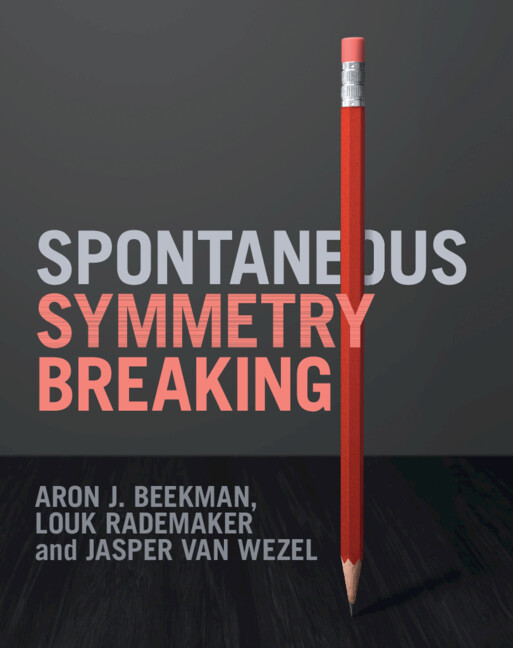
Title: Spontaneous Symmetry Breaking
Author: Aron J. Beekman, Louk Rademaker and Jasper van Wezel
ISBN: 9781009575768

Aron J. Beekman obtained a Ph.D. in theoretical physics from Leiden University. He has held research positions in Japan at RIKEN, National Institute for Material Science, and Keio ...
View profile >Louk Rademaker obtained a Ph.D. in theoretical physics from Leiden University. He has worked at the Kavli Institute for Theoretical Physics in Santa Barbara, the Perimeter Institut...
View profile >Jasper van Wezel obtained a Ph.D. in theoretical physics from Leiden University. He subsequently held prize fellowships at the University of Cambridge and Argonne National Laborato...
View profile >Keep up with the latest from Cambridge University Press on our social media accounts.



Latest Comments
Have your say!